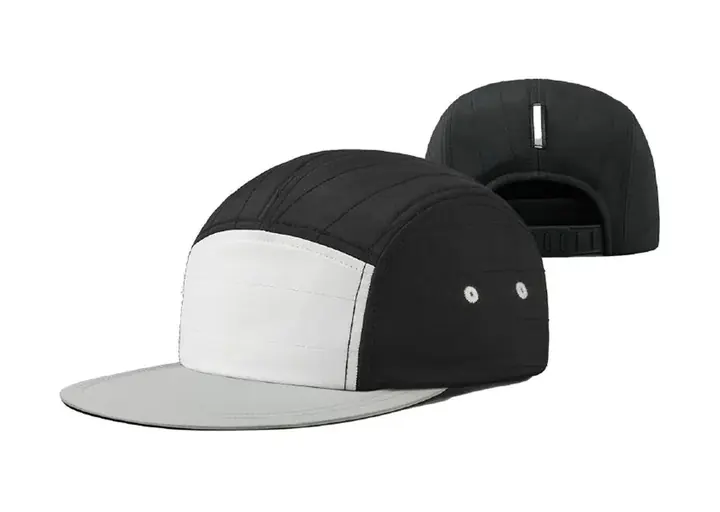
A custom five-panel camper cap should be specified as a complete product, not simply as a “5-panel hat.” The buying brief needs to describe the crown profile, panel geometry, fabric, visor shape, rear adjustment, decoration, inside finish and approved size range. These choices determine whether a cap works for an outdoor lifestyle brand, a streetwear collection or a light-activity merchandise program.
For a concrete sourcing starting point, LOSTCAPS lists model 5128 as an unstructured, quilted five-panel camper cap with a 100% nylon material reference and a 58 cm reference size. Selected stock colors using the existing construction may start from 50 pieces per color and style. Custom colors, materials or structural development may require 300 pieces or more, subject to the final specification and quotation. The planning sample period is 7–10 days once key construction and artwork details are confirmed; new materials or specialized components may extend development. See performance headwear model 5128 for the current reference and request a project-specific quotation.
Quick answer: what belongs in a custom camper cap specification?
Before asking suppliers to quote, confirm:
- Front, side, rear, top and inside photographs of the intended silhouette
- Five-panel construction, target crown height, width and depth
- Structured or unstructured crown, and whether quilted panels or lining are required
- Fabric category and confirmed composition, plus requested feel, weave, weight and finish
- Visor length, width, curve, stiffness, edge and top/underside colors
- Rear closure type, intended adjustment range and comfort requirements
- Logo method, final dimensions in millimeters, placement and color references
- Sweatband, internal seam treatment, care label and private-label details
- Target quantity by style and color, destination market and delivery requirement
- Physical-sample approval criteria for fit, shape, decoration and workmanship
A supplier can make a more useful recommendation from this brief than from an unsupported claim such as “premium waterproof five-panel cap.”
What makes a camper cap different from another five-panel cap?
“Five-panel” describes a construction family; “camper” usually describes a low-to-mid-profile, outdoor-influenced silhouette that may use a relatively flat or lightly curved visor. But the term is not a controlled dimension standard.
Some five-panel styles have a broad uninterrupted front panel; others use seams or extra stitching across a quilted surface. A high-profile foam-front trucker and a soft camper-style cap can both have five panels while looking and fitting very differently.
Specify what the wearer should see from the side: how the crown slopes, how far the front stands away from the forehead, how the visor projects, and whether the top collapses naturally when the cap is off the head. Record those decisions on a physical reference or annotated photographs.
If the main question is choosing panel count, first use 5-Panel vs 6-Panel Caps: Which Construction Fits Your Brand?. This guide focuses on what to develop and approve *after* the buyer has selected a camper-cap direction.
1. Define the crown profile and fit before selecting fabric
An unstructured crown usually depends more on the fabric, stitching and internal finishing for its shape than a stiff reinforced front. An apparently small change in fabric or lining can change how the front panel sits on the forehead.
Ask the supplier to document:
- Crown height at center front and at the side
- Overall crown depth from front to rear
- Width and position of the front panel
- Side-panel shape and seam direction
- Top-panel or dart arrangement when applicable
- Whether the front has any reinforcement or lining
- Intended head circumference and the useful closure-adjustment range
A single “one size” label does not prove fit. Use an actual sample to check the lowest and highest intended head sizes, the shape over the temples and how the rear opening behaves after adjustment.
For model 5128, 58 cm is a catalog *reference size*. It does not establish a tested adjustable range, and the final fit must be checked on the selected development sample.
2. Compare nylon, cotton and technical woven fabrics by use case
Fabric choice changes the hand feel, appearance, stiffness, decoration compatibility and practical order minimum. A fabric described as “nylon” or “polyester” still needs an identified composition, weave, finish and, when relevant, weight.
Nylon woven fabric
Nylon is one possible direction for outdoor-inspired camper caps where a smoother or technical appearance is desired. Ask whether the exact candidate material is plain woven, ripstop, quilted or another construction. Confirm coating or treatment separately rather than assuming all nylon is water repellent.
Cotton twill or canvas
Cotton can suit casual and heritage camper collections that prioritize a matte, familiar surface. Twill and canvas are not interchangeable: compare hand feel, fold behavior, visible weave and how the selected fabric responds to decoration and washing.
Stretch woven and blended fabrics
A stretch composition may help a cap follow movement, but the amount of stretch and recovery varies by material and pattern. Ask for composition, construction and sample behavior; do not assume “stretch” guarantees one-size fit.
Quilted constructions
A quilted camper cap adds a visible stitched pattern and may introduce a lining or added layers. Specify quilting-line spacing, direction, seam alignment, internal bulk and how the quilting affects logo placement. Ask whether quilting appears on each panel or only selected panels.
Compare actual swatches on the chosen crown before approving a fabric change. Review How to Choose Fabric for Custom Caps and Hats for a wider fabric selection framework.
3. Specify water repellency and other performance claims carefully
“Water repellent,” “water resistant” and “waterproof” should not be treated as synonyms. A treated fabric may shed some surface moisture while the assembled hat still has seams, stitch holes, openings and components that are not waterproof.
If water repellency is required, ask which exact fabric finish is proposed, how it will be assessed, what care conditions apply and which claims are supported by documentation or tests. Do not add a waterproof rating, UPF rating, recycled-content percentage or guaranteed quick-dry performance without appropriate evidence for the final production material.
Model 5128 is presented with a water-repellent *reference* in its catalog description. That is a development direction, not proof of a particular final test result.
4. Choose the visor as part of the silhouette
The visor can make two similar camper crowns look like different products. Specify its shape, attachment angle and behavior on the worn cap.
For the sample approval sheet, record:
- Center-front visor length and how it is measured
- Maximum width from side to side
- Flat, gently curved or pre-curved target
- Type and intended stiffness of the visor insert
- Visible rows of stitching and outer-edge finish
- Upper and underside fabric and color
- Whether the visor should be bendable or packable
- Symmetry between the two sides after assembly
A soft brim is not automatically packable; evaluate whether it returns to an acceptable shape after the proposed handling. A very flat visor also does not establish how the finished cap will sit on the wearer's head.
Use How to Measure a Custom Cap Visor: Brim Length, Width and Curve to align dimensions and measurement methods before requesting the sample.
5. Select a rear closure for both look and comfort
Common camper-cap directions can use snapback components, self-fabric straps, webbing adjusters or other low-profile closures. A premium-looking closure is not necessarily the most comfortable one.
Ask for the selected closure in open, fully adjusted and worn positions. Check whether hard components press against the back of the head, whether the strap end is secured, whether loose hair catches and whether the closure keeps the cap stable during intended use.
Also confirm the rear opening geometry and space for a woven label or small rear logo. If the rear structure changes between two candidate closures, the cap may need more than a simple hardware substitution.
Review How to Choose a Custom Hat Closure: Snapback, Buckle and Fit Guide for a detailed comparison.
6. Decide logo placement from the actual panel geometry
A broad camper front is often attractive for a clean brand mark, but quilting, seams, low crown height and soft material can limit decoration.
Flat embroidery
Consider flat embroidery for clear lettering or simple marks when the actual fabric and crown support stitching without visible puckering. State logo width, height, placement, thread colors and required detail.
Heat transfer or print
Transfers may work for appropriate artwork on compatible fabrics. Test adhesion, hand feel and surface appearance on the *selected* finished material, especially if there is a coating or textured quilting beneath the logo.
Silicone, TPU or woven patch
These can be evaluated for a technical or retail-style effect, subject to material compatibility. Check weight, edge lift, flexibility, attachment and inside comfort; a thicker patch may distort a soft crown.
Private-label inside details
If branded seam tape, a care label, a woven size label, hangtag or retail bag is required, include it in the same sample approval rather than adding it after the crown and logo are signed off.
Use How to Specify Logo Placement on a Custom Cap: A B2B Buyer Guide and customization options to prepare the logo brief. A screen mockup can confirm scale and general position, but it cannot confirm finished embroidery, adhesion or panel distortion.
7. Approve a physical sample using buyer-facing checkpoints
A physical development sample is the central control point. Ask for front, side, top, rear, underside and on-head images, but check the actual sample where practical.
Fit and silhouette
Confirm the intended crown profile, front-panel angle, reference head size, rear adjustment and comfort across the target wearers. Compare it with the approved reference cap at the same camera angle.
Material and construction
Check the stated fabric composition and surface against approved swatches. Inspect quilting alignment, panel seams, top construction, sweatband, inside seam finish and any lining. Check whether the visor joins the crown symmetrically.
Branding and care
Measure the actual logo dimensions and distance from seams or visor. Check small text, color, stitch or transfer quality, backing and inside comfort. Verify the planned label and packaging details, then document the intended care check.
Approval record
Photograph any correction with a measuring tape or ruler, label each change by revision number and maintain one written decision list. Do not rely on isolated messages such as “make the brim a little shorter.” If revisions alter the fabric, pattern or decoration, confirm whether a new sample or setup charge applies.
The wider physical inspection sequence is available at Custom Cap Sample Approval Checklist.
8. Plan MOQ, quantities and quotation honestly
MOQ should be quoted for the complete specified style, not copied from a general category banner. Fabric sourcing, custom dyeing, quilting, closure components, branded trim and allocation across colors can each change the practical minimum.
For LOSTCAPS model 5128, selected stock colors with the existing construction may start from **50 pieces per color and style**. Custom colors, materials or structural development may require **300 pieces or more**, depending on the final specification. The planning sample period is **7–10 days** after essential details are confirmed. Check performance headwear model 5128 and confirm material availability, color allocation and the project-specific MOQ before ordering.
When comparing quotes, request the same construction, color breakdown, logo locations, labels, packaging, shipping term and destination. Keep sample charges, development or setup charges, production unit prices and freight identifiable instead of treating the lowest quoted unit price as the complete cost.
A finished production date should be confirmed only after the final specification, approved physical sample, quantity and material availability are known.
A quote-ready custom five-panel camper cap brief
Copy this information into your request to LOSTCAPS:
- Product direction: unstructured five-panel camper cap, or a link to model 5128
- Intended buyer use: outdoor lifestyle / brand merchandise / light activity
- Front, side, rear and inside reference photographs
- Crown height, depth, reference head size and adjustment requirements
- Fabric composition, feel, desired weave, finish and color reference
- Quilting design or confirmation that no quilting is needed
- Visor length, width, curve, flexibility and edge finish
- Rear closure preference and any no-hard-hardware requirements
- Front, side, back and inside branding with vector logo files
- Private-label artwork and packaging requirements
- Quantity by style and color, delivery country and required date
- Requested sample checks and any destination-market documentation needs
Browse the verified reference at performance headwear model 5128 or compare broader options at custom performance caps. Send the completed brief via request a custom headwear quote so the team can review construction, stock-fabric options, the practical MOQ and sampling.
FAQ
Is a camper cap always a five-panel cap?
Camper is a style description rather than a guaranteed factory pattern. Many camper caps use five panels, but buyers should still confirm panel count, front seams, crown profile and visor on an actual reference.
Is a five-panel camper cap the same as a five-panel trucker cap?
Not necessarily. A trucker cap may use a foam or structured front and mesh back, while a camper direction may be softer and use woven fabric across the crown. Panel count alone does not determine fit or construction.
What is the MOQ for custom camper caps?
It depends on the specific style, fabric and branding. For LOSTCAPS model 5128, selected stock colors using the existing construction may start from 50 pieces per color and style. Custom colors, materials or structural development may require 300 pieces or more; confirm the final specification and project-specific quotation.
Can I order model 5128 with a different fabric or color?
Custom direction can be reviewed, but availability and MOQ need confirming against the proposed material, color and component requirements. The catalog's 100% nylon line is a reference, not a promise that all replacements are available.
Is the quilted camper cap waterproof?
A catalog reference to water-repellent construction does not prove a waterproof finished cap. Ask for evidence for the actual approved fabric and assembly before making a protection claim.
Can I embroider a logo over quilted panels?
It may be possible depending on quilting placement, logo size, thread density and the support behind the panel. Approve the result on the exact fabric and assembled cap; a flat digital mockup is insufficient.
How long does a custom camper cap sample take?
For model 5128, the current planning estimate is 7–10 days after core specifications are confirmed. New materials, unusual trims, artwork changes or tooling can extend development time.
What should I send if I only have a reference cap photo?
Send front, side, rear, top and inside views, plus the intended changes, target quantity, logo and delivery country. Add measurements and ideally a physical reference before treating the specification as final.