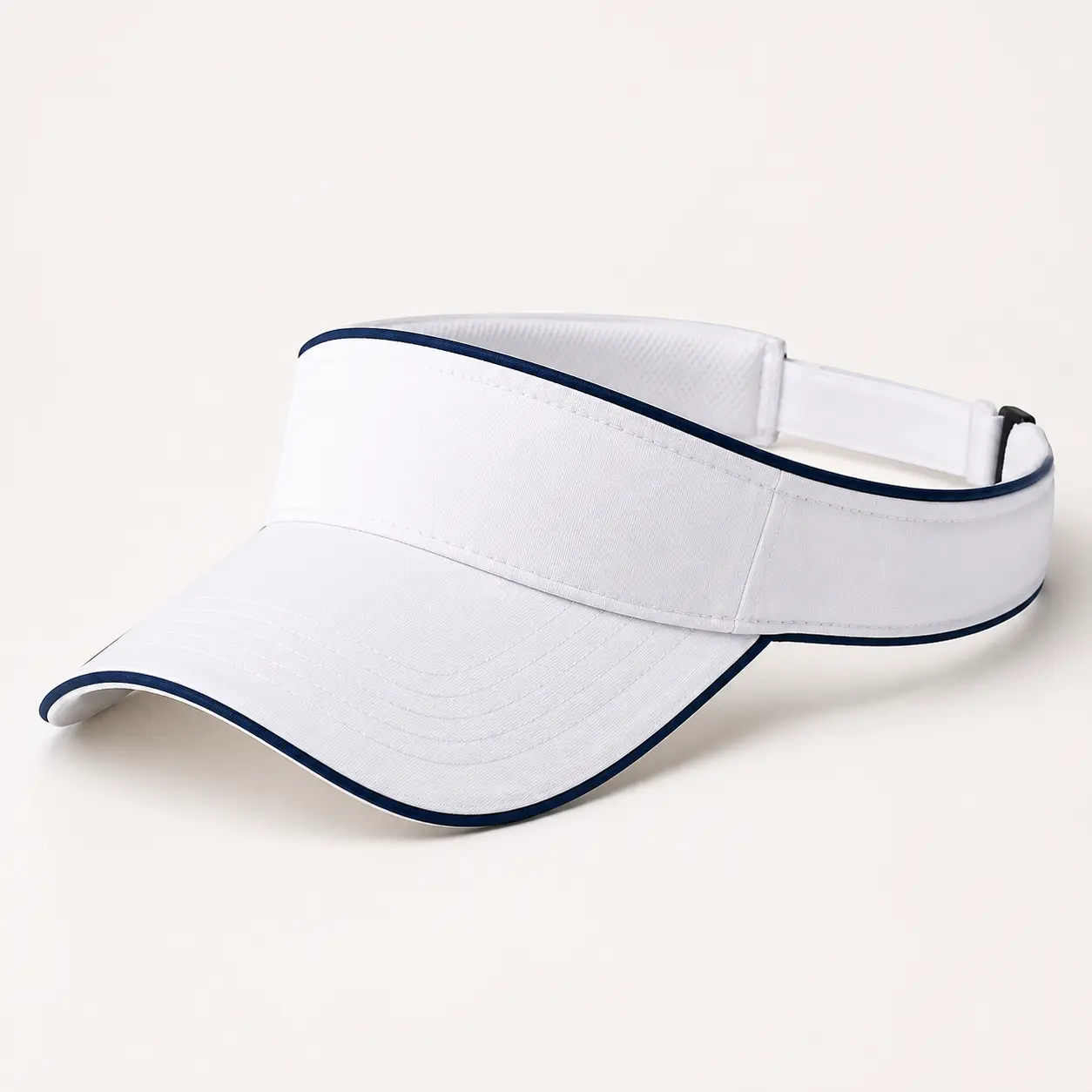
A custom tennis visor is an open-top headwear product, not merely the brim of a baseball cap. For a tennis academy, padel club, pickleball tournament, golf event or branded resort collection, the buying decision involves the headband fit, shaped brim, sweatband, back adjustment, logo method and repeat-order specification. A comfortable visor with the wrong closure or a distorted front logo is not an approved sample.
This B2B guide explains what procurement teams should request before quoting, sampling and approving a private-label visor. As a real product starting point, review LOSTCAPS /products/sports-visor-cap. That catalog page identifies an open-top sports visor with a shaped brim, sweatband, cotton-twill or quick-dry-polyester material options, and embroidery, heat-transfer and woven-label decoration. A product photograph is a reference, not a guarantee that every requested combination is available on the same terms.
Quick answer: what should a tennis club send for a visor quotation?
Send one consolidated brief containing:
- A link to /products/sports-visor-cap or your own authorized reference photos, including front, side, back and inside views
- Intended use: match play, coaching, academy merchandise, tournament giveaway, retail or staff uniform
- Headband width and height, desired fit range and preferred adjustable-closure type
- Brim projection, width, curve, underside color, edge finish and required stiffness
- Requested fabric, composition, color and sweatband characteristics
- Final club artwork, logo width and height, decoration method and placement
- Any inside label, packaging, sponsor branding or individual name requirements
- Quantity **per style and color**, target delivery date, shipping destination and requested delivery term
- The physical-sample acceptance checks and the person authorized to approve production
For a coordinated club program, /solutions/racquet-club describes a headwear and apparel concept that includes a performance visor. Its program-level 100-piece-per-style reference should not be confused with the separate Sports Visor Cap product's standard starting MOQ.
1. Confirm that you need an open-top sports visor
Buyers often use the terms tennis visor, sun visor, golf visor and cap visor interchangeably. A **sports visor** typically has a headband and projecting brim but no full crown covering the top of the head. A **cap visor** can also mean only the projecting brim attached to a complete baseball cap. These are different products.
An open-top style can suit players who prefer less material over the scalp. However, its coverage, stability and comfort depend on the specific headband, brim and closure. It is not automatically cooler or more protective than every cap. If the end user needs crown coverage, compare actual technical cap options at custom performance caps rather than assuming an open-top visor meets the brief.
Specify the intended wearer and use. A retail tennis collection may prioritize brand presentation and color consistency; a competition or coaching program may prioritize secure fit during movement, sweatband comfort and easy adjustment. The approved construction must serve the actual requirement.
2. Measure the headband and fit range before approving a logo
A visor has no crown depth to hold it in place, so the band and closure become particularly important. Ask for measurements on the complete sample, not a generic one-size label.
Record:
- Front headband height measured at the center
- Side-band height and where the band sits above the ears
- Band circumference range with the adjustment fully shortened and extended
- Fit method: hook-and-loop, strap, slide buckle, elastic or another approved construction
- Amount of stretch, if any, and whether that stretch comes from fabric, elastic or the closure
- The inside contact surface, exposed seams and any labels that might touch skin
- Comfort and stability during the intended movement or playing activity
Measure circumference using the agreed method and confirm the position on the wearer's head. An adjustable visor still needs physical fit testing across the expected size range. If the club requests youth and adult versions, treat them as separately specified fittings unless the sampled pattern has been verified for both.
Compare front and side photographs on an actual wearer or appropriate head form. Check for gaps above the forehead, band riding upward, pressure at the temples and movement during a practical wear trial. Record the assessment instead of claiming that a product is pressure-free for every wearer.
3. Specify brim projection, curve and construction
The brim creates the visor's characteristic profile. Ask the supplier to measure its center-front projection, maximum width, edge thickness and curve on the completed sample. State whether the projection is measured along the surface or as a straight line; those methods are not interchangeable.
Check the brim from the side as well as the front. A deeper curve can change its apparent width, view of the court and visual balance with the headband. Confirm the material and stiffness of the internal insert, its edge treatment and whether any requested folding or packing behavior is compatible with that construction.
Do not assume that a visor can be repeatedly folded merely because the fabric feels light. If packability is essential, define a handling test and approve the result on a physical sample. Do not claim a UPF rating or a quantified level of UV protection based on the brim's appearance. Any tested protection claim needs evidence for the finished item.
For measurement terminology, How to Measure a Custom Cap Visor: Brim Length, Width and Curve explains how to describe brim length, width, curve and stiffness. That guide covers baseball-style cap brims as well, so apply its measurement principles to the actual open-top visor sample rather than copying another pattern's dimensions.
4. Choose fabric for the real wearing environment
LOSTCAPS /products/sports-visor-cap lists **cotton twill or quick-dry polyester** as material directions. These are options, not evidence that every finish or color exists in both materials.
Cotton twill direction
Cotton twill can provide a familiar textile texture for lifestyle club merchandise and classic branded visors. Review surface appearance, weight, color consistency, shrinkage after the intended care method, and how the band feels after wearing. The composition and wash instructions must be confirmed for the chosen sample.
Quick-dry polyester direction
Polyester may be appropriate for a more technical-looking visor. Review the actual weave or knit, hand feel, finishing, moisture behavior and suitability for embroidery or heat transfer. The label "quick-dry" should not replace a specific test or approved reference when performance is part of the buyer's purchase requirement.
Contrast trims and underside fabric
A light band with dark piping, a contrasting brim underside or colored binding can support a club identity. Define every color separately and inspect joining lines and seam symmetry. Do not assume the fabric, trim and thread will match the same Pantone reference exactly without sampling.
If the club expects a wash, abrasion or colorfastness standard, agree the test method and applicable requirement before production. A general product description is not a laboratory report.
5. Treat the sweatband as a core product component
An open-top visor contacts the forehead through its interior band. Ask what the sweatband is made from, how wide it is, whether it contains foam or elastic, how it is attached and how it should be cared for.
On the sample, inspect:
- Contact comfort along the forehead and temples
- The location of seams, folded edges and label corners
- Whether the sweatband remains aligned when the closure is tightened
- How it feels when damp under the agreed wearing or care test
- Visible color transfer, seam distortion or odor after the specified cleaning method, if those checks are required
- Whether replacement or additional lining changes the size and price
Do not describe absorbency, moisture-wicking speed or antimicrobial performance as certified without documentation specific to the selected material and construction. The practical buying question is whether the physical sample meets the club's agreed comfort and care brief.
6. Review the rear closure under movement
LOSTCAPS lists adjustable closures as a customization direction for its Sports Visor Cap. Select the closure based on the wearer, desired retail presentation and comfort requirements, rather than assuming that every buckle or strap is interchangeable.
A hook-and-loop closure can be simple to adjust, but inspect the exposed edge and whether it catches hair or garment fibers. A buckle-and-strap construction can present a cleaner look, but its hardware must be checked for pressure and slippage. Elastic can make adjustment easier for some uses, but the actual fit range and recovery behavior require evaluation.
Specify the closure material, color, strap width, exposed tail length, label position and adjustment range. During approval, wear the visor through the intended motions and check whether the closure slips or presses uncomfortably. An image of the closure cannot substitute for a wearing trial.
If a requested non-stock closure alters the construction, ask whether it changes tooling, MOQ or sample timing before confirming a small order.
7. Choose logo decoration by artwork and fabric
The first question is not "can the logo be printed?" but "what result is needed at the finished size on the selected band?"
Embroidery
Embroidery can create a tactile logo that suits many club crests and simple lettering. The front band has limited height compared with a full baseball-cap crown. Provide final dimensions and check the clear area above the brim seam and away from piping. Dense embroidery may alter the feel of a thin or flexible band; verify the actual stitch result, backing and inside comfort.
Small text and thin round outlines may need adjustment before embroidery. Ask for a stitch sample and approve legibility before bulk production. Raised 3D puff embroidery should not be assumed viable for tiny or highly detailed visor artwork.
Heat transfer
Heat transfer can be considered for flat or fine multicolor artwork where the fabric and band construction suit the process. Confirm transfer type, application area, hand feel, edge adhesion and the applicable care method with a finished sample. A digital mockup does not establish adhesion or wash durability. Changing the transfer color or process after approval may require new preparation and another sample.
Woven labels and subtle branding
A woven label or small branded detail may suit an understated retail program. Decide whether it goes on the outside band, near the closure or inside. Verify that the label does not rub the wearer and that no sponsor name or customer logo is added without the brand owner's permission.
For a broader comparison of decoration choices, see Embroidery, Patch or Print: Which Logo Method?. Use How to Specify Logo Placement on a Custom Cap: A B2B Buyer Guide to specify measurements and artwork position; adapt its placement principles to the smaller open-top visor band.
8. Approve club colors, labels and packaging together
Tournament collections and academy merchandise frequently need several colors, but each additional colorway can affect dye matching, stock availability, decoration cost and practical minimum quantity.
Give the supplier a color breakdown such as white/navy piping and navy/white logo, then request a physical color reference on the selected fabric and trim. Do not rely on a computer display for final approval. If you need sponsor marks, identify which artwork is authorized and which positions are genuinely available on the visor; avoid putting large decoration over uncomfortable seams or the back adjuster.
Ask whether the quotation includes inside size or care labels, individual polybags, hangtags, barcodes and carton assortments. Agree how mixed colors and sizes will be packed, and check whether retail packaging has a separate minimum or tooling charge. Your receiving team should be able to identify the correct style, color and approved artwork version without opening every carton.
9. Interpret MOQ, sampling and production timing by product and program
The current /products/sports-visor-cap page lists a **50-piece MOQ** for the reference style and a **7–10 day sample lead time** after the specification and artwork are confirmed. LOSTCAPS's general technical-headwear guidance applies 50-piece starting quantities to suitable existing styles and available fabric colors; non-stock colors or structural changes can raise the practical minimum to **300 pieces**. Confirm every style-and-color split in the quotation rather than treating the catalog figure as unconditional.
The /solutions/racquet-club solution lists **100 pieces per style** for its coordinated program. That is a different scope from quoting one existing Sports Visor Cap style. Do not combine the two numbers into a single universal minimum.
For the reference Sports Visor Cap, the public product page indicates typical bulk production of **15–18 days for 50–300 pieces** and **20–25 days for 500–1,000 pieces**, after sample and specification approval. These are planning estimates, not confirmed delivery dates or international transit times. A special fabric, new color, redesigned closure, multiple branding positions, packaging requirement or production-calendar conflict can affect feasibility and schedule.
Request separate line items for the physical sample, decoration setup, any tooling, unit price, packaging and international freight. For normal custom cap sampling, LOSTCAPS commonly quotes a USD 50 sample fee, but the actual visor sample cost and shipping must be confirmed for your requested specification. Do not approve tooling or bulk purchases until the written quotation and physical sample are accepted.
10. Use one physical sample and approval record for repeat orders
A sample is useful only when the supplier and buyer share the same approved reference. Before production, inspect the visor for:
- Correct open-top silhouette, headband height, curve and fit range
- Brim dimensions and shape measured by the agreed method
- Correct fabric and trim, including inside sweatband and stitching
- Rear-closure comfort, adjustability and security
- Logo width, color, alignment, spelling and technique
- Inside finishing, label placement, care wording and seam comfort
- Packing, carton sorting, quantity split and any barcode requirements
- Documented revisions and the person giving final written approval
Take front, rear, side, underside and wearer-fit photographs of the approved physical sample. Record the final specifications and any deviations, and keep a versioned approval sheet for a later repeat order. Use Custom Cap Sample Approval Checklist for the broader pre-production process.
LOSTCAPS describes its background as **15 years of manufacturing and export experience**. Buyers should still judge the chosen visor against actual sample quality, project-specific quotation, agreed inspections and shipment records rather than assuming that experience alone guarantees an outcome.
Quote-ready tennis visor purchasing checklist
To receive a comparable B2B quotation through request a custom headwear quote, send:
- Product reference: /products/sports-visor-cap or authorized reference photographs
- Target user and occasion: club retail, academy, tournament, resort or team
- Headband and brim specifications, including preferred adjustment method
- Chosen material, available or custom color direction and sweatband requirements
- Vector logo, physical dimensions, Pantone references and all required branding positions
- Quantity by style and color, with any youth/adult size split
- Label, hangtag, bag and carton requirements
- Requested physical-sample checks and approval owner
- Destination market, required arrival date and preferred shipping terms
- Any specific testing or regulatory documents actually required by your market
Use /solutions/racquet-club for the coordinated club-merchandise direction, or send the single-visor reference through request a custom headwear quote if the requirement is only headwear. This keeps the quotation focused on the real buying decision rather than an assumed bundle.
FAQ
What is the difference between a tennis visor and a cap visor?
A tennis sports visor is open at the top and normally consists of a headband, brim and rear adjustment. A cap visor can also refer to the brim component attached to a full baseball cap. Specify which complete product you need.
What is the MOQ for custom tennis visors?
The verified LOSTCAPS Sports Visor Cap listing starts at 50 pieces for that style. Existing available materials and colors are the practical low-MOQ route; non-stock colors or structural changes can raise the requirement to 300 pieces. A coordinated racquet-club merchandise program separately lists 100 pieces per style. Confirm the final MOQ per style and color in writing.
How long does a custom visor sample take?
The Sports Visor Cap product page lists 7–10 days once the selected specification and artwork are confirmed. Additional revisions, non-stock trims or a new construction can change the schedule. International sample courier time is separate.
Is embroidery or heat transfer better for a small tennis club logo?
Neither is automatically better. Embroidery may suit simpler logos and textured finishes; heat transfer may suit finer or flatter color artwork on suitable materials. Review the exact logo size and fabric, then approve a physical decoration sample before production.
Can I order one visor style in several club colors?
Possibly, but ask for the quantity by color and check which fabrics and trims are in stock. A 50-piece starting minimum should not be interpreted as permission to divide a small order across unlimited custom colors.
Are tennis visors UV protective or waterproof?
A brim can offer some shade, but no quantified UPF, waterproof or UV-protection claim should be made without evidence relevant to the final material and construction. Request documentation or testing if your selling market needs that claim.
What must I check before placing a repeat visor order?
Keep the approved physical sample, band and brim dimensions, material and color references, exact logo art and positioning, closure specification, label details, packaging instructions and signed approval version. Confirm whether any component has changed since the last order.