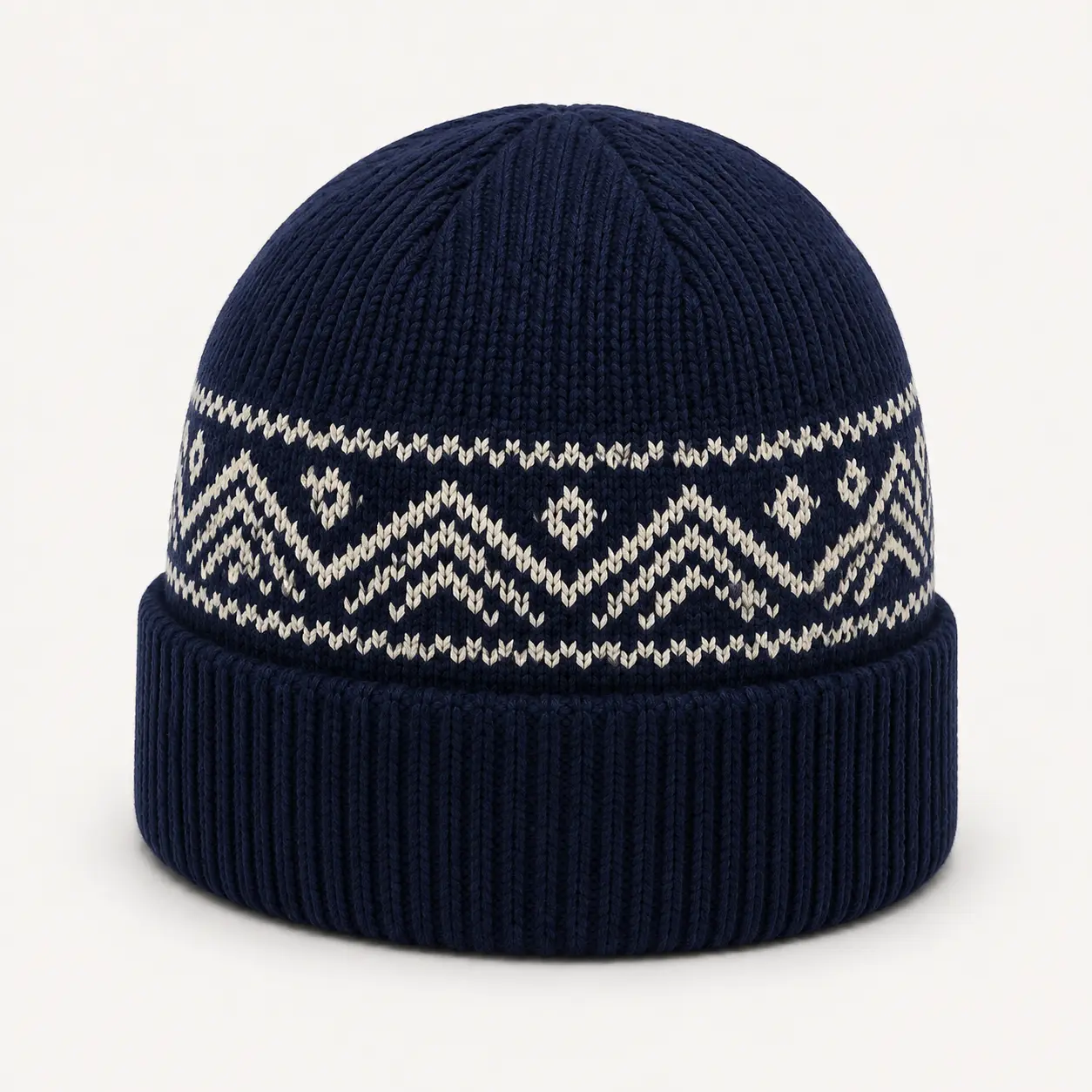
A private-label beanie can carry a logo in two fundamentally different ways: jacquard knitting builds the design into the knitted structure, while direct embroidery stitches a design onto a knitted beanie. Neither method is automatically better. A buyer should select by artwork, planned knit, finished fit, intended use, color requirements and the physical sample.
This comparison is for brand owners, sports clubs, team-merchandise buyers and distributors deciding between knitted-in graphics and embroidered cuff branding. It goes beyond a generic beanie sourcing guide by addressing the production decisions that make the two logo methods look and behave differently. Start with the verified LOSTCAPS product references Custom Jacquard Knit Logo Beanie and OEM Private Label Cuffed Beanie, then compare the details below before requesting a quote.
Quick answer: when should a brand choose jacquard or embroidery?
Choose jacquard knitting when the graphic is meant to be part of the fabric: bold lettering, a repeat pattern, stripes coordinated with a club identity, or a large integrated motif. Yarn colors, stitch structure, graphic scale and the appearance of the reverse side all need approval together. Jacquard is not the best starting assumption for extremely tiny text or photographic gradients.
Choose direct embroidery when the brand wants a defined front or cuff logo on an existing knit silhouette, especially if the design should read as a separate stitched mark. Embroidery thread can create a clear visual focus, but the selected knit may stretch or compress under the embroidery. Fine details, stiffness, backing and logo position must be approved on the finished beanie.
For either method, compare the actual physical sample in relaxed and worn states. Digital artwork alone cannot establish legibility, fit, hand feel or consistent placement.
1. The key manufacturing difference
Jacquard: the logo is part of the knit
Jacquard uses different yarn colors and a programmed knit pattern to form a graphic as the fabric is made. A stripe, large wordmark or repeating motif can cover an area that would be impractical to embroider as a single dense graphic. The practical limit is the selected knitting construction and its ability to render the intended shapes at a chosen gauge.
This is not a printed graphic applied afterward. The buyer must specify the yarn colors, motif dimensions, placement relative to the cuff and crown, and whether the graphic repeats around the circumference. Inspect the back of the knitted graphic for floats, joins or other construction characteristics that may matter for comfort and finishing. A supplier should confirm these points for the selected knit; do not assume every jacquard construction has the same reverse-side appearance.
The listed Custom Jacquard Knit Logo Beanie is a relevant example: its product specification identifies a soft acrylic jacquard knit with knitted lettering, all-over graphics, woven labels and optional pom-poms. These are catalog capabilities to discuss in a quote, not a claim that every customer design can be reproduced unchanged.
Embroidery: the logo is stitched onto the knit
Direct embroidery follows an approved digitized design and stitch program on a previously made knit surface. This can suit a compact brand name, emblem or carefully simplified team mark. However, knitting is stretchable and stitching adds a more stable area. Dense embroidery may change how the cuff bends or how the opening feels.
Agree whether the logo goes on the front cuff, the beanie body or another location. Check any stabilizer or backing, the inside finish and the way the decoration sits after the cuff is folded. The embroidered design should remain visually balanced when worn, not merely when laid flat.
The verified OEM Private Label Cuffed Beanie reference lists embroidery and woven-label options on a cuffed knit base, alongside private-label and packaging customization.
2. Which method preserves small lettering and detailed logos?
Neither method should be approved from pixels on a screen alone.
For jacquard, each knitted segment must translate into the selected stitch structure. Narrow gaps, thin curves, small serifs and complex diagonal lines can become blocky or less distinct, especially if the logo is reduced. Contrast between yarn colors also changes the perceived edge quality. Ask for a knitted artwork proof and a physical sample at the intended size.
For embroidery, fine lines and small letters are limited by physical thread, stitch density, underlay and the movement of the knit. A digital design with closely spaced details may need simplification or enlargement. Digitizing an existing logo does not guarantee that fine features will survive on a ribbed cuff.
Before sampling, mark the must-keep logo elements, final width and height, minimum readable lettering and allowed simplifications. If the brand cannot approve the resulting design, consider a different logo treatment, such as a woven label or patch, rather than forcing an unsuitable tiny motif.
For vector-file preparation and logo-size approval, consult How to Prepare Logo Artwork for Custom Hat Embroidery: A B2B File Checklist. Its file checklist also helps when the final decoration is jacquard, although jacquard will need a knitting-specific interpretation.
3. How do color requirements affect the choice?
Jacquard graphics are formed using the selected yarn colors. Color matching depends on the specific yarn, fiber composition, availability and the allowed number of colors in the construction. A digital Pantone reference is a target to review, not proof that a particular yarn exists in that shade. Multiple yarn colors can influence development, order minimums and price.
Embroidery introduces separate thread colors on top of a knitted background. The same nominal color may appear different because of thread sheen, yarn texture and viewing direction. Ask the supplier to compare physical thread and yarn samples under consistent lighting.
For a club program, decide whether a two-color knitted graphic is more important than an exact small sponsor emblem. A jacquard beanie with an added embroidered detail may also be technically possible for a defined project, but it should be costed and sampled as a separate combination, not assumed from one reference product.
Keep approved physical color references for the body, lettering, patch or label. See Pantone Color Matching for Custom Hats: A B2B Buyer’s Approval Guide for the broader color-approval process.
4. Compare feel, stretch and fit after decoration
Beanie fit depends on yarn, knit structure, opening circumference, body length, cuff depth and recovery. Decoration can change the way the fabric moves.
A large jacquard area may behave differently from a plain rib section. Check whether the graphic distorts when the beanie is stretched, whether a repeat pattern aligns, and how the crown and cuff sit in a worn position. Inspect the reverse-side texture where it touches the wearer.
A dense embroidered logo can add a relatively firm area to an otherwise flexible cuff. Check whether the cuff rolls, twists or presses uncomfortably at the decoration. Review backing edges and whether stitching shows through to the inside.
For both approaches, ask for relaxed laid-flat width and height, folded cuff depth and a clear measurement method. Then test actual fit on the intended wearer range. A nominal one-size description is not a substitute for wear approval.
5. Decide where the graphic belongs before requesting a price
A knitted-in pattern may wrap around the beanie, sit across the front or repeat on the cuff. For a continuous motif, the buyer needs to agree how it begins and ends near the rear seam and whether it remains visually aligned after the cuff is folded.
An embroidered logo is normally a more localized mark. Record its center point, width, height and distance from the cuff edge in the approved folded position. If the cuff depth can be changed by the wearer, state whether the mark must remain visible at more than one fold.
Do not assume that moving an approved design from the cuff to the body is a trivial change. The background knit and stretch may differ, and a new sample or decoration setup may be required.
6. MOQ and sample timing: compare the actual product program
The two verified LOSTCAPS custom product references, Custom Jacquard Knit Logo Beanie and OEM Private Label Cuffed Beanie, each list a starting MOQ of 100 pieces. Plan the quotation by style and color, and clarify the number of graphics, yarn shades and private-label components. Additional colors, special yarns or a different knit structure can change the practical minimum.
An in-stock blank beanie with a logo added may be a separate 50-piece-per-color program when that exact stocked style and color are available and the decoration is approved. That possibility is not a 50-piece promise for a newly knitted jacquard design or for either 100-piece catalog style. Ask for written confirmation before planning quantities.
Both listed custom beanie references state 10–15 days for a sample after the specification and artwork are confirmed. That is a product-specific reference, not a guaranteed calendar date for every custom-yarn or multi-color development. Bulk production and shipping should be quoted only after the knit, design, color split, sample sign-off and order quantity are known.
If a buyer changes logo scale, yarn arrangement, embroidery program or label dimensions after approval, ask for the additional sampling, setup cost and schedule before authorizing the revision. Approval should cover the physical sample and written specification, not just a rendering.
7. What should a supplier quote separately?
A useful side-by-side comparison keeps construction and decoration choices visible instead of using an ambiguous unit price.
Ask each supplier to identify:
- The exact beanie silhouette, relaxed measurements and approved cuff depth
- Fiber composition, yarn reference and knit structure
- Jacquard chart or embroidery size, method and number of colors
- Decoration position and any extra label, patch or pom-pom
- Color count and order split by style and color
- Physical sample and setup charges, including revision rules
- Bulk unit price at the same agreed quantity and specifications
- Packaging, delivery term, destination and freight assumptions
- Planned sample dispatch, production lead time and approval milestones
A quote for a simple embroidered stock-style cuffed beanie cannot be compared fairly with a custom-knit jacquard beanie unless yarn, packaging, labels and delivery terms are also specified.
8. Physical sample approval checklist
Ask to see both a laid-flat photo and a worn or fitted view, but make the sign-off against the physical sample.
- Confirm the beanie height, relaxed width, cuff depth and intended wearing position
- Check the logo's exact width, height, shape and visual center after folding
- For jacquard, inspect the knitted shape, yarn contrast, motif repeat, seams and reverse-side knit
- For embroidery, inspect legibility, density, alignment, backing and the cuff's feel
- Stretch and release the sample to observe recovery and possible distortion
- Check yarn or thread colors against approved physical references
- Confirm spelling, labels, care information, trim attachment and packing
- Record approved photos, dimensions and file revisions for production comparison
Do not use a visualization as proof of measured performance, fiber content or compliance. Confirm those claims from actual materials and appropriate supporting evidence when needed.
9. Private-label branding can involve more than one method
A retail-ready beanie may combine a knitted body graphic with a small woven brand label, or a plain knit with cuff embroidery and an inside composition or care label. The presence of a label does not determine the best main logo method.
Define whether the outer logo is the brand identifier, club name or seasonal artwork. Then specify the inner label, label dimensions, attachment points, hangtag and individual packing in one brief. Review all branding together so the logo is not hidden by the fold, a label does not feel abrasive and the packing shows the approved retail presentation.
For a broader beanie construction checklist, read How to Source Custom Beanies: A B2B Buyer’s Specification Guide. The related custom beanies page offers starting styles for further comparison.
10. A quote-ready brief for your first private-label beanie
Send the supplier one consolidated document:
- Buyer type and intended use: private-label retail, team, club or promotional merchandise
- Selected reference: Custom Jacquard Knit Logo Beanie or OEM Private Label Cuffed Beanie
- Required colorways, fiber or yarn direction and fit measurements
- Editable logo art, a clearly labelled preview and final dimensions
- Jacquard pattern coverage or embroidery location, including cuff fold
- Color references for beanie body, knitted-in graphic or thread
- Optional inside label, hangtag, patch, pom-pom or packaging
- Target quantity by style and color and delivery destination
- Desired delivery timing and who will approve the physical sample
With 15 years of manufacturing and export experience, LOSTCAPS can review a defined custom-headwear brief. The next step is a project-specific feasibility and quotation check, not a promise that every design, minimum or production date is identical. Use request a custom headwear quote to send the complete specification.
FAQ
Is jacquard better than embroidery for a beanie logo?
Jacquard is useful when the design is meant to be part of the knit, particularly larger graphics or repeats. Embroidery suits localized stitched marks. Select by logo detail, knit structure and the approved physical sample rather than calling one method universally better.
Can jacquard knitting reproduce small text exactly?
Not necessarily. Very small characters and fine edges must translate to the selected knitting structure. Review a knitting-specific artwork proof and sample. Simplification, enlargement or another decoration method may be needed.
Does embroidery reduce the stretch of a cuffed beanie?
A dense stitched area can behave differently from the surrounding stretch knit. The effect depends on logo size, stitch density, backing and cuff construction. Check the finished sample in both relaxed and worn positions.
What is the minimum order for these LOSTCAPS beanie products?
The listed custom Jacquard Knit Logo Beanie and OEM Private Label Cuffed Beanie each start at 100 pieces. Certain confirmed in-stock blank beanies with an added logo can follow a separate 50-piece-per-color program; that is not the MOQ for a new jacquard construction.
How long does a sample take?
The two referenced custom beanie product pages currently list 10–15 days after specification and artwork confirmation. Custom yarn, colors, trims, revisions and project complexity can change the actual schedule.
Can I add a woven label to a jacquard or embroidered beanie?
Both referenced product directions mention private-label options. Confirm the label material, size, artwork, attachment position and any cost or minimum changes before sample approval.
What must be signed off before bulk production?
Approve the actual beanie's dimensions, fit, knit, colors, graphic legibility, decoration, inside finish, private labels, packaging and revision version. Keep the approved physical sample and written specification as the production reference.