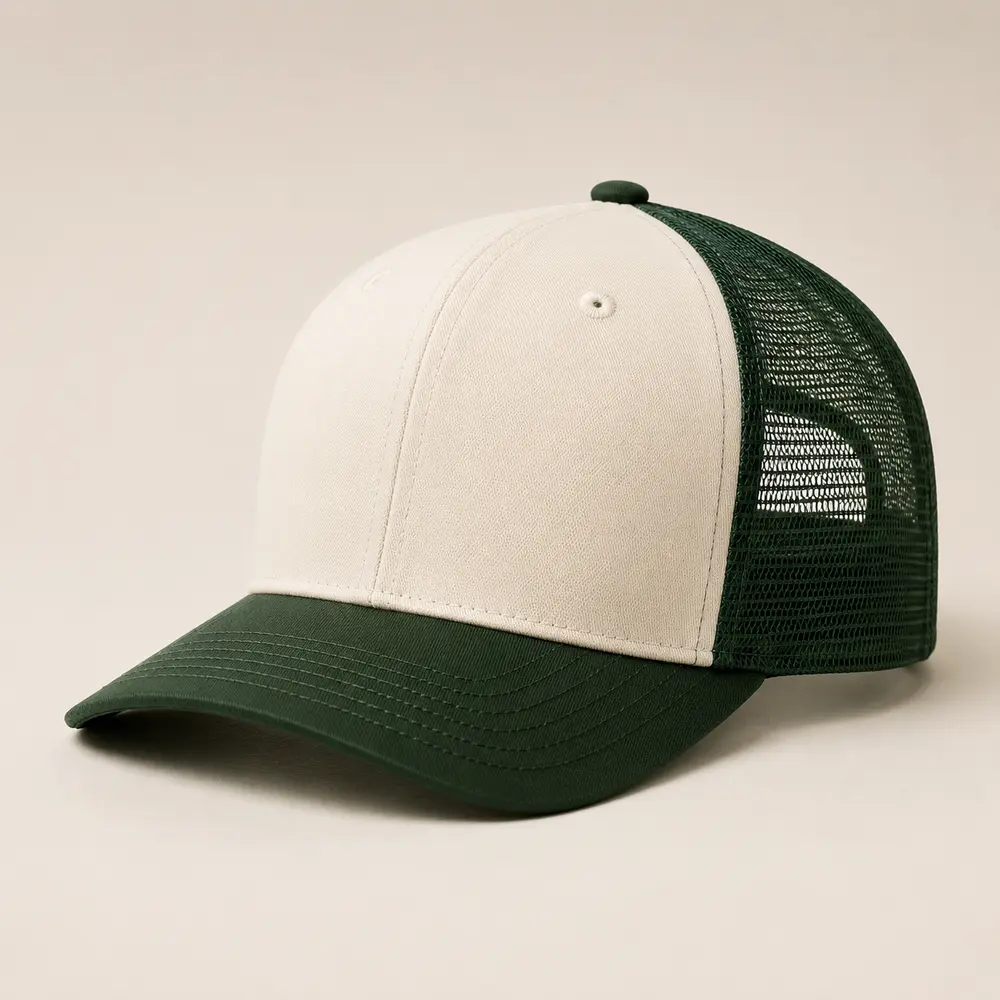
A two-tone trucker cap can look simple in a photograph: one color on the front, another on the mesh. In production, however, the front panel, visor, mesh, top button, thread, snap closure and private-label components can each carry a different color or finish. Buyers who approve only a front-view digital mock-up may discover that the mesh looks too light, the front panel feels wrong or the logo no longer contrasts once a physical sample arrives.
This guide is for overseas apparel brands, clubs, wholesalers and merchandise buyers planning a color-blocked trucker cap. It focuses on mesh-and-front-panel color approval, sample controls, labels and quote-ready specifications. For general crown profiles, mesh types and closure choices, start with Sourcing Custom Trucker Hats: A B2B Buyer’s Specification Guide.
Quick answer: how should a buyer approve a two-tone trucker cap?
Approve one complete, physical cap specification, including these checkpoints:
- **Front-panel construction:** foam, cotton twill or another confirmed material; record its structure, crown height and exact color reference.
- **Mesh:** actual color, hole pattern, softness or stiffness, stretch and visual transparency on a finished cap.
- **Color blocking:** specify front panel, side or rear mesh, visor top, underbrim, button, eyelets, sewing thread and closure colors individually.
- **Branding:** exact logo artwork, dimensions, method, thread or patch colors, placement and visibility against the selected front material.
- **Private label:** inside woven label, care or composition label, sweatband, seam tape, hang tag and packing requirements.
- **Quantity:** specify pieces **per color combination and style**, rather than combining multiple colorways to reach the starting MOQ.
- **Sign-off:** front, side, rear, inside and angled photographs plus an approved physical sample and a version-controlled tech pack.
Treat a two-tone design as a set of component decisions, not as a single generic Pantone number.
1. Define exactly what “two-tone” means
Two-tone may describe a dark foam front with white mesh, a cotton front with a contrasting visor, or a fabric front whose rear mesh and closure share a second color. These are not interchangeable specifications.
For each proposed SKU, build a color map:
- Front crown panels: material, base color, finish and front-panel structure
- Rear and side mesh panels: material, color and mesh pattern
- Visor upper fabric: matching front, matching mesh or a separate approved choice
- Underbrim: matching, contrasting or another approved reference
- Top button and eyelets: matching or contrasting where the construction includes them
- Stitching: matching or intentionally visible contrast
- Snapback closure: molded plastic color and finish, where applicable
- Logo and label: thread, ink, patch base, woven-label ground and text colors
Ask the supplier to identify whether your combination uses existing approved components or needs special fabric or mesh sourcing. A style labeled “black and white” is not a complete SKU specification: it may mean black front with white mesh or the reverse.
2. Foam front versus cotton-twill front: choose before matching color
Foam-front trucker: bold color blocks and an upright surface
Foam-front truckers often offer a broad visual area for print or a patch, with mesh rear panels and a pronounced vintage or promotional silhouette. Foam density, front-panel height and backing can affect how a logo looks and how the cap sits on the head.
The existing LOSTCAPS /products/flat-brim-foam-trucker-cap reference lists a foam front with polyester mesh, a flat brim and color combinations including red/white and black/white. Use that product as a construction reference; confirm actual available combinations and the approved logo method at quotation stage.
For a foam-front sample, inspect whether the front panel creases, puckers or distorts under the selected decoration. Do not assume that dense embroidery works identically on a foam panel and a woven twill panel.
Cotton-twill front: textile texture and a different logo result
A cotton-twill front can support a lifestyle or workwear direction, but the weave, wash, reinforcement and panel seams change the surface. Color seen on solid cotton may appear richer or less bright than the same nominal color on open polyester mesh.
LOSTCAPS has a /products/distressed-mesh-trucker-cap reference with a cotton-twill front and polyester mesh in combinations such as red/black and orange/khaki. Its distressed finish is a specific visual feature; if your brand needs a clean, non-distressed cap, say so instead of assuming the same reference is available without modification.
Before asking for new colors, confirm whether you need a foam-front or fabric-front cap. Changing the front construction after color approval can invalidate the logo, shape and pricing decisions.
3. Why the same Pantone reference may look different on mesh
Solid woven fabric and open mesh present different visible surfaces. Mesh holes let the background show through; polyester filament, coating, hole size and knit construction can also change perceived shade. A supplier may match a fabric to a requested color reference, yet the mesh can look lighter or darker on a wearer or in photographs.
Use Pantone Color Matching for Custom Hats: A B2B Buyer’s Approval Guide for the broader material-by-material color process. For a two-tone trucker cap, apply three additional checks:
- View the front fabric and rear mesh together on the actual sewn sample, not as separated flat swatches.
- Assess the cap over a neutral background and on a head form under controlled lighting, then check it in typical daylight.
- Photograph front, side and rear views with the approved color reference and record whether the intended relationship is “match,” “coordinate” or “contrast.”
If the design intentionally uses two different colors, define each separately. If the goal is a near match, approve the appearance of the two materials together rather than promising identical measured color on unlike surfaces. A phone image alone cannot guarantee exact color.
Specify mesh itself, not only its shade
Record mesh-hole scale, visual density, stiffness, stretch direction and recovery. A more open mesh can make a pale color look different over dark hair, while a firm mesh can change the cap silhouette. Ask the factory to confirm the material and reproduce it on bulk orders.
Review the join between mesh and front fabric. Look for uneven seam lines, twisting, visible excess thread, color show-through or pulling at the side panels.
4. Approve the entire cap's color map
Many color discrepancies are not on the most obvious two components.
Visor and underbrim
A black front with white mesh might use a black visor, a white visor or a third specified accent. Record the upper and lower visor separately and approve the curve or flat shape. Changing the visor fabric or color after sample approval can change the apparent contrast and the final price.
Stitching, button, closure and trim
Matching black sewing thread may nearly disappear on black twill yet remain visible on white mesh. An adjustable plastic closure can also look different from woven fabric even when both are described as white.
Check the top button, seam threads, sweatband, closure and any rope trim where applicable. If a component has no verified color option, ask for a feasible alternative before treating it as committed.
Colorways are distinct SKUs
Create a simple one-row-per-colorway table in your tech pack. For example, “black front / white mesh / black visor / white embroidery” and “cream front / forest mesh / cream visor / forest embroidery” are different combinations. Request separate samples or explicit written approval for every material and logo change; do not infer that one approved sample validates every colorway.
5. Choose the logo technique for the selected front panel
Branding should be reviewed only after the front material and intended cap profile are selected.
**Flat embroidery:** review stitch density, small letters, color, needle penetration and puckering on the actual panel. Embroidery thread is matched from available yarn or thread references; a Pantone number is a target for comparison, not proof of exact yarn-color availability.
**3D puff embroidery:** best considered for bold raised shapes that can be digitized and supported by the chosen crown. Fine lettering and narrow negative spaces may need flat embroidery or simplified artwork. Approve edge coverage and raised appearance on the real sample.
**Patch or print:** evaluate patch size, edge, attachment and stiffness, or print adhesion and legibility for the chosen surface. Screen printing, transfer and embroidery are not automatically interchangeable across foam and twill.
The selection depends on artwork, panel material and project specification. LOSTCAPS can review options at customization options, but final feasibility and any setup charge must be confirmed before the sample is made.
Check logo contrast across both proposed colorways
A white logo on a dark front may work well, while the same artwork can lose contrast on a cream front. Record thread or ink colors per SKU rather than assigning one logo file and assuming all outputs will remain legible.
For retail brands, also approve distance from the visor seam, any center seam and the upper crown edge. Measure the visible finished logo on the cap, not just the artwork's outer canvas.
6. Make private-label details part of the sample
Private label means more than adding front embroidery. For a retail-ready two-tone trucker, confirm:
- Brand woven label: size, fold, color, attachment point and visibility
- Care and fiber-content label: agreed content and position, based on verified materials and destination requirements
- Inside seam tape: plain or branded, color and width
- Sweatband: material, color, comfort and logo placement if any
- Hang tag or barcode sticker: exact artwork and SKU identification
- Packaging: folding restrictions, polybag or retail presentation, quantity per carton
- Repeat-order specification: material references, logo file version, colorway codes and approval photos
Do not assume every label or special closure is available at the standard minimum. In particular, special rear-strap sewn labels, custom trims and nonstandard color sourcing can have separate minimums or charges. Confirm these by item before budgeting.
Do not include a previous client's logo, packaging or photographs unless that client has authorized their use. Use your own artwork and approved product references for development.
7. MOQ, sampling and lead time for a two-tone wholesale order
For a standard LOSTCAPS trucker-cap construction using feasible existing components, the starting MOQ is **50 pieces per color and per style**. You cannot combine 25 black/white and 25 cream/green caps to satisfy a 50-piece minimum. A separate front construction is a different style even if the logo is identical.
Special mesh colors, non-stock fabric, structural changes, labels and custom hardware may require higher minimums. The supplier must confirm this against the exact component list; “from 50 pieces” is not a blanket promise for every possible two-tone combination.
A standard cap sample generally takes **7–10 days** after the specification, artwork and sample payment are confirmed. Additional development or custom sourcing may take longer. Typical bulk production planning for established specifications is **15–18 days for 50–300 pieces** and **20–25 days for 500–1,000 pieces**, subject to confirmed materials, approvals and factory scheduling. Transit and customs are additional, and arrival dates must be quoted separately.
LOSTCAPS has **15 years of manufacturing and export experience** through Suzhou Yunxingmei Import & Export Co., Ltd. For your project, the useful control is still a signed-off sample and clear component specification—not a broad claim that every color, finish or quantity is immediately available.
8. Physical sample approval: front, mesh, branding and repeatability
Use a checklist that can be reused for bulk inspection. Record pass/fail or required changes against the actual approved reference.
- **Shape and fit:** crown height, profile, brim size, curve, closure adjustment and wearer fit
- **Front-panel fabric:** composition, texture, structure, selected color and absence of unwanted distortion
- **Mesh:** hole size, softness, stretch, color, transparency and consistent attachment
- **Color block:** contrast relationship between front, mesh, visor, underbrim, closure and thread
- **Logo:** final width, placement, stitch or print quality, thread/ink/patch shade and durability direction
- **Private label:** correct woven labels, sweatband, internal branding and tags
- **Workmanship:** even seams, clean trims, secure attachment and finish against the approved sample
- **Packing:** correct colorway code, quantity labels and shape-preserving presentation
Approve one full-size physical sample with the intended production materials. Keep the photos and approval date. If a mesh, fabric, logo or trim substitute is proposed later, review the change and decide whether a new sample is required.
9. A quote-ready two-tone trucker-cap brief
Send this information in your first inquiry:
- Target market and planned use: retail, workwear, sports club, festival or promotional merchandise
- Reference construction: foam front or cotton-twill front; catalog link or your own design reference
- One color map for every SKU: front, mesh, visor, underbrim, button, thread and closure
- Desired mesh hand feel, hole density and cap fit
- Logo vector art, technique, size, position and thread or ink references per colorway
- Private-label components, care label and packing requirements
- Target quantity **per colorway and style**, plus forecast reorders if known
- Destination country, shipping terms, desired delivery window and sample approval process
Browse custom trucker caps and compare the two confirmed product references before sending your brief at request a custom headwear quote. Ask for a written line-item quote stating what is standard, what requires development, the actual MOQ, sample cost and shipment assumptions.
FAQ
Is black-and-white automatically the same specification across two trucker factories?
No. Different foam, mesh, front-panel patterns, brim inserts, snap closures and sewing methods can change the shape and perceived color. Compare actual samples using the same written specification.
Can the front fabric and rear mesh match one Pantone color exactly?
A Pantone reference is useful for setting a target, but solid woven fabric and open mesh can appear different. Review the finished materials side by side and approve an acceptable match or contrast.
Can I order 25 caps in each of two colorways?
Not under the standard 50-pieces-per-color-and-style starting MOQ. Ask for a quote for at least 50 pieces of each approved standard colorway, and confirm any higher minimum for special components.
Does a custom trucker cap sample take 7–10 days including shipping?
No. This is a typical standard sample-making timeframe after confirmation. Courier transit, special development and the buyer's own approval time are separate.
Are special colors, sewn rear labels and logo methods all included at the 50-piece minimum?
Not necessarily. Stock construction, special fabrics, trims and rear-strap sewn labels can have different minimums and costs. Ask for each item to be confirmed in the written quote.
What should we retain for repeat orders?
Retain the approved physical sample, exact color maps and component references, mesh specification, pattern details, logo production file, label art, packaging instructions and approved photos for each SKU.