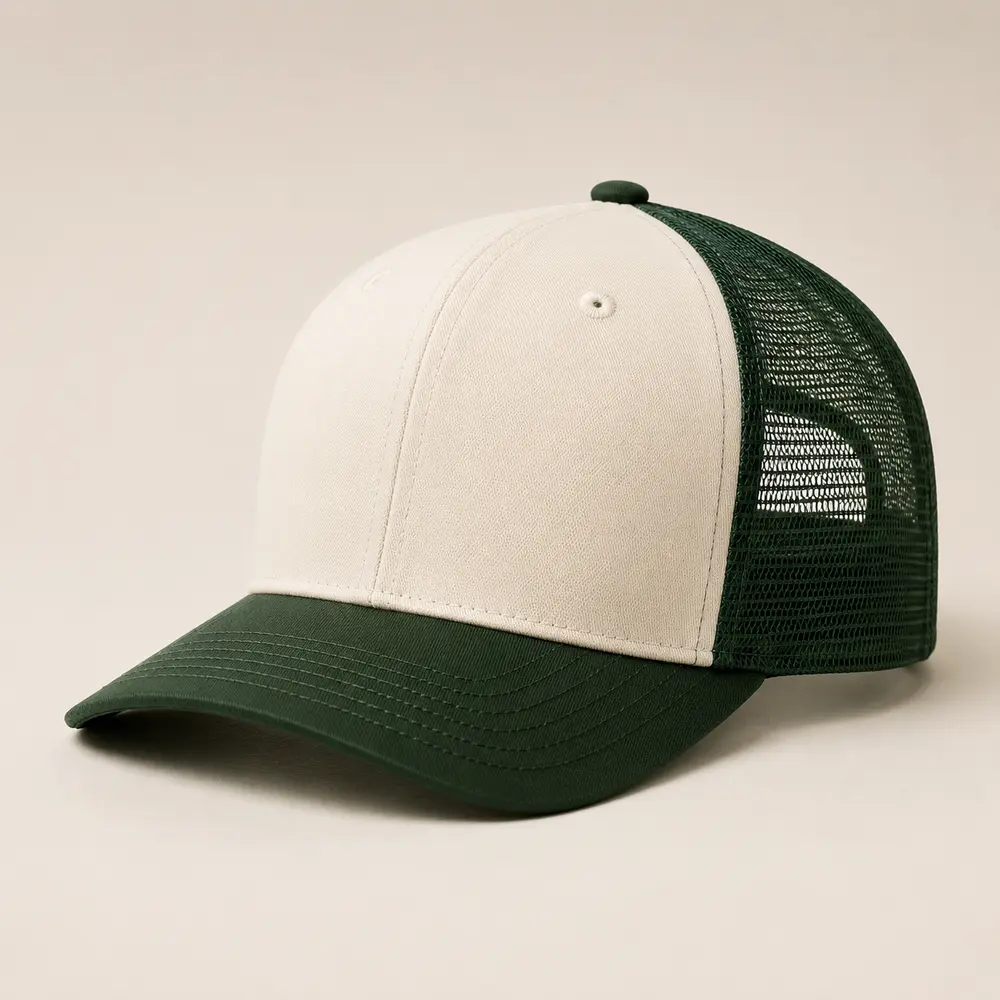
Front-panel support determines whether a cap keeps a firm retail shape, follows the wearer's head or collapses into a softer silhouette. Buyers often describe this choice only as "structured" or "unstructured," but suppliers still need to know the selected cap pattern, support location, stiffness direction, fabric, logo method and approved physical sample.
This guide helps brands, distributors, teams and merchandise buyers prepare a quote-ready front-panel support brief without assuming that one material name guarantees a particular finished shape.
Quick Answer: What Should a Buyer Approve?
Approve the complete cap, not a loose support material. Record:
- Cap style, panel count and crown profile
- Structured, lightly supported or unstructured direction
- Which front panels receive support
- Supplier-proposed support or buckram construction
- Main fabric and hand-feel direction
- Target front shape from front and side views
- Logo method, size, placement and backing
- Breathability and wearer-comfort requirements that need testing
- Inside appearance and seam finishing
- Fit across the intended head-size range
- Approved physical sample and specification version
- Bulk comparison and change-control rules
A digital mock-up can show a front logo and crown outline. It cannot prove stiffness, recovery, pressure points, heat build-up, how the crown sits when worn or whether the front keeps its shape after handling.
1. Start with the Finished Silhouette
Decide how the cap should look on the intended wearer. A firm promotional or sports cap may need a clean upright front, while a washed dad cap may need a softer crown that follows the head. A streetwear snapback can require a higher and more defined front than a low-profile casual cap.
Use front, side and three-quarter reference views. Mark the desired crown height, front angle, top transition and how much the front may relax when the cap is not worn.
Review Cap Crown Profiles and Fit: A Buyer’s Guide before using support material to correct the wrong crown pattern.
2. Define Structured, Lightly Supported and Unstructured
Structured front
A structured cap uses internal support to help the front panels keep a defined shape. The exact support may vary by supplier and cap construction. Ask the supplier to identify the proposed solution and show the inside of the sample.
Lightly supported front
A lighter support direction can retain some presentation shape without feeling as firm as a fully structured crown. This is useful when the brief needs a cleaner front but a softer wearing feel.
Unstructured front
An unstructured cap normally relies more on the outer fabric, seams and pattern. It can fold or drape more easily, but "unstructured" does not mean that every internal layer is removed or that all fabrics will collapse in the same way.
Do not approve only the category name. Compare the actual sample silhouette, hand feel and recovery.
3. Ask What the Supplier Means by Buckram
Buckram is commonly used as a general term for front-panel reinforcement, but the material, weight, stiffness, resin or bonding method and panel coverage can differ. Record the supplier's construction reference instead of specifying an unsupported material claim.
Ask:
- Which panels are supported?
- Is the support sewn, fused or otherwise integrated?
- What stiffness direction does the sample represent?
- Does the support extend into seam allowances?
- Is there an additional logo backing?
- How does the support behave after normal handling or the intended care method?
- Will changing the cap fabric change the result?
Do not infer fiber content, recycled content, adhesive chemistry or tested durability from appearance alone.
4. Coordinate Support with the Main Fabric
A soft washed cotton, firm twill, foam front, corduroy, canvas or lightweight performance fabric can behave differently over the same support direction. The outer material and internal construction must be approved together.
Check for:
- Smooth front-panel surface
- No bubbles, ripples or visible bonding marks
- No unwanted shine or color change
- Clean panel seams
- Consistent left and right shape
- No excessive thickness at the lower front
- Acceptable recovery after packing and handling
For material decisions, use How to Choose Fabric for Custom Caps and Hats and How to Choose Fabric Weight for Custom Caps.
5. Match the Support to the Logo Method
Embroidery, patches and print place different demands on the front panel. A firm support can help present some embroidery cleanly, but additional stitch backing, thread density, artwork size and seam placement also affect the result.
Direct embroidery
Confirm whether the design crosses a center seam, its physical width and height, stitch direction, fine details and whether puckering appears around the finished logo.
Raised 3D embroidery
3D embroidery needs artwork with suitable stroke width and a cap construction that supports the intended raised result. Front support alone does not make every design suitable for 3D work.
Patches and print
Approve patch thickness, attachment method and edge behavior on the actual crown. For printed or transferred artwork, confirm material compatibility and whether heat or pressure changes the front-panel appearance.
Compare methods at Embroidery, Patch or Print: Which Logo Method? and prepare artwork through How to Prepare Logo Artwork for Custom Hat Embroidery: A B2B File Checklist.
6. Check Fit, Comfort and Internal Finish
Front support can change how the cap feels across the forehead and how the crown sits on the head. Review the complete cap with its sweatband, seam tape, closure and selected size range.
Inspect:
- Pressure at the lower front edge
- Rough or exposed support edges
- Bulk where panels meet the sweatband
- Interior seam and tape coverage
- How the crown contacts the head
- Whether the front leans, twists or feels overly rigid
- Fit at the tightest and loosest intended closure positions
- Comfort during the intended wear trial
Avoid universal comfort or breathability claims. Test the selected construction with representative wearers and document the approved result.
7. Approve the Cap When Worn and When Removed
A supported front may look different on a head form, on a wearer and resting on a table. Photograph all three conditions using the same angles.
Check whether the cap:
- Holds the approved front angle
- Remains symmetrical
- Returns to its intended shape after light handling
- Shows unwanted dents or panel collapse
- Keeps the logo correctly oriented
- Maintains the planned relationship between crown and visor
- Packs and unpacks in an acceptable condition
If recovery or packability is commercially important, agree a project-specific test before bulk production rather than adding a new standard afterward.
8. Physical Sample Approval Checklist
- Confirm cap style, five- or six-panel pattern and crown profile
- Record structured, lightly supported or unstructured direction
- Identify supported panels and supplier construction reference
- Approve main fabric and front-panel hand feel together
- Compare front, side and three-quarter silhouette
- Inspect inside construction and lower-edge comfort
- Confirm logo method, size, placement and backing
- Check puckering, ripples, bubbles and visible support marks
- Wear-test the cap across the intended fit range
- Review shape before and after normal handling
- Photograph the approved cap on and off the head
- Save the approved physical sample and specification version
- Require reapproval if fabric, support, logo or pattern changes
9. Bulk Production and Quality Control
Use the approved sample as the reference. Representative bulk checks should confirm:
- Correct cap style and colorway
- Correct front support direction
- Consistent crown height and front angle
- Symmetrical left and right panels
- Smooth front surface without bubbles or distortion
- Correct logo size, placement and finish
- No excessive embroidery puckering
- Clean internal edges and seam finishing
- Correct sweatband, taping and closure
- Acceptable fit and handling recovery
- Correct labels, packing and SKU identification
Agree how samples are selected and compared before production. Do not introduce a new stiffness description after finished goods are completed.
10. MOQ, Sampling and Quotation Conditions
For regular baseball, trucker and snapback caps, the established LOSTCAPS baseline starts from 50 pieces per color and design when the selected cap, available support construction and decoration are feasible. Colors and designs should not be combined to reach one 50-piece minimum.
A new crown pattern, special support material, custom-dyed component, unusual bonding requirement, private labels or special packaging can change the practical MOQ, setup, price and timing. Confirm the exact construction before quotation.
A physical cap sample is generally planned at 7–10 days after the cap, fabric, support direction, artwork, colors and payment are confirmed. Production and international shipping are separate.
Ask the quotation to separate the cap base, front-panel construction, logo method, labels, packing, sample or setup, freight and delivery term.
Quote-Ready Front-Panel Support Brief
Send:
- Intended wearer and use
- Cap style, panel count and crown profile
- Front, side and inside reference photographs
- Structured, lightly supported or unstructured direction
- Main fabric and color reference
- Approved support sample or supplier construction reference
- Logo artwork, method, dimensions and placement
- Quantity per color and design
- Fit range, labels and packing requirements
- Delivery country and target date
- Person responsible for sample approval
Compare starting styles at custom baseball cap manufacturing, review the development process at customization options, or send the complete brief through request a custom headwear quote.
FAQ
Is buckram the same as a structured cap?
Buckram can be part of a structured front, but the finished shape also depends on the crown pattern, fabric, seams, visor connection and complete construction. Approve the finished cap.
Does an unstructured cap contain no internal material?
Not necessarily. "Unstructured" describes the overall support direction, not a universal bill of materials. Ask for the actual inside construction.
Will a firmer front always improve embroidery?
No. Artwork, stitch density, backing, fabric, seam position and machine setup also matter. Review the finished logo on the selected cap sample.
Can front support change cap fit?
Yes. Stiffness, thickness and the lower front edge can affect how the crown sits and feels. Approve fit on the complete cap with its sweatband and closure.
What MOQ applies?
Regular baseball, trucker and snapback projects generally start from 50 pieces per color and design when the selected construction is feasible. A new pattern or special support material can require a higher project-specific minimum.
Is a physical sample necessary?
Yes. A sample is needed to judge silhouette, stiffness, recovery, logo appearance, inside finish, fit and comfort before bulk production.