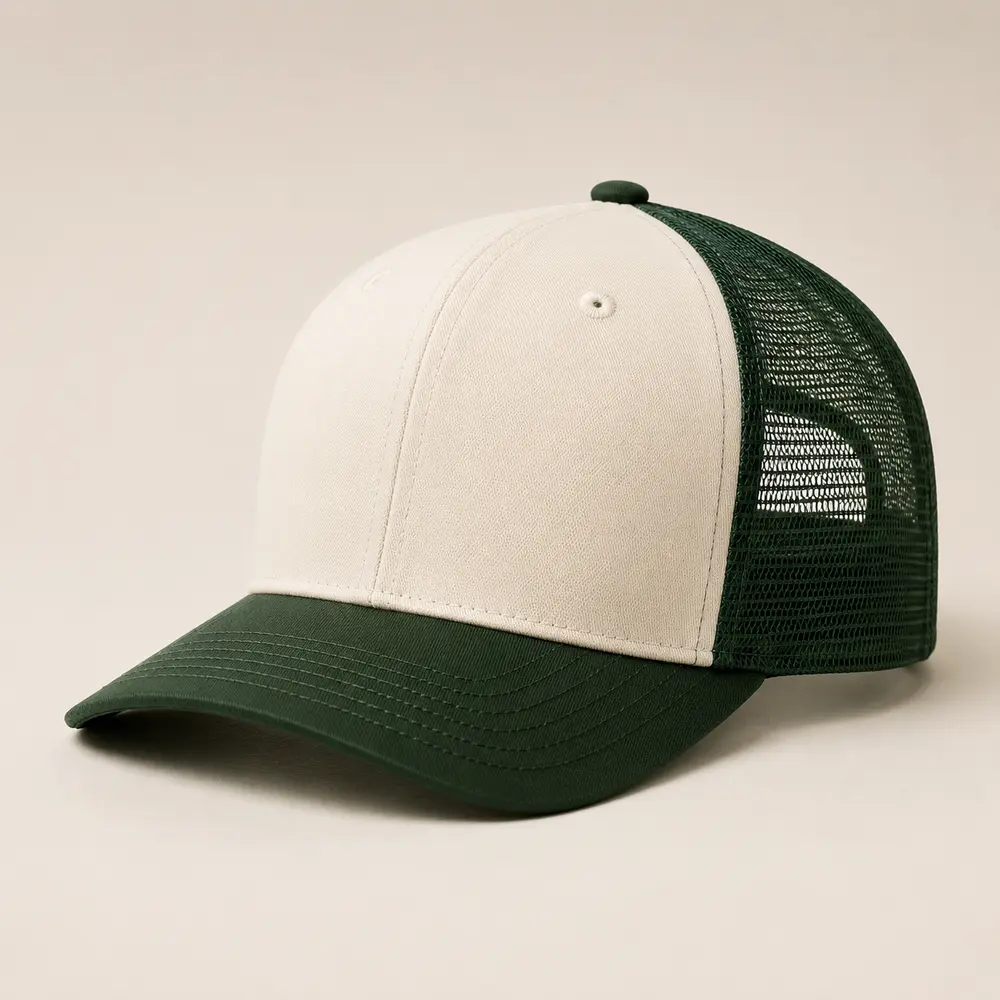
A custom rope cap uses a cord fixed across the front edge of the visor to create a golf, resort or retro-sport look. The cord is not a generic add-on: its diameter, material, color, attachment points and distance from the front logo all affect the finished silhouette. Buyers should approve the rope on a physical cap sample before bulk production.
Quick answer: what should a rope-cap specification include?
Send the cap silhouette, crown construction, visor shape, rope diameter, rope material, color reference, attachment method, front-logo size and placement, closure, inside branding, order quantity and delivery market. Include front, side and underside reference images. Ask the supplier to confirm which details use an existing pattern and which require custom development.
Choose the cap body before the cord
Rope trim is commonly associated with five-panel, trucker, golf and outdoor-inspired caps, but the same rope can look different on each shape. A tall structured crown creates a more upright profile; a low soft crown produces a quieter casual look. The visor may be flat, pre-curved or flexible, and its width determines how the cord sits across the front.
Do not approve the cord independently from the cap body. First confirm the crown height, panel layout, visor length and width, rear closure and target fit. Compare available silhouettes in custom trucker caps and custom performance caps, then confirm whether the rope will be added to an existing base or a new pattern.
Specify rope diameter and material
Small changes in cord diameter can materially change the front profile. A thin cord can appear subtle; a thicker cord can become the dominant design detail. Measure the finished diameter in millimeters on the physical sample rather than relying on words such as thin, standard or chunky.
Ask the supplier to record:
- Finished cord diameter and visible length.
- Fiber or material construction and surface texture.
- Solid, twisted, flecked or multicolor appearance.
- Stretch, stiffness and recovery where relevant.
- Color reference under normal daylight.
- Whether the ends are sealed, folded or hidden inside attachment points.
- Whether the rope is washable with the selected cap fabric.
If a precise brand color matters, provide a physical swatch or an agreed color standard. Screen colors alone are not a reliable production reference.
Approve placement and attachment
The cord normally follows the front edge of the visor, but its exact height and tension change the appearance. If it sits too high, it may crowd the logo; if it sits too low, it can roll toward the visor edge. Confirm the center position and both side attachment points in millimeters.
Attachment methods vary by construction. The ends may pass into side seams, sit beneath tabs or be stitched at controlled points. Inspect both sides for symmetry, secure stitching and clean finishing. Check that the rope does not twist, sag or pull the visor out of shape when the cap is worn.
Protect clearance around the front logo
Approve the logo and rope together. Record the logo's finished width and height, its distance from the visor seam and the minimum visual clearance above the cord. A tall embroidered patch or large 3D logo may compete with a thick rope. Small lettering may also lose clarity when raised embroidery is used.
Send vector artwork when available and review How to Prepare Logo Artwork for Custom Hat Embroidery: A B2B File Checklist before sampling. Ask for a one-to-one placement proof, but treat it as a positioning check rather than proof of the final texture. The physical sample remains the approval reference.
Coordinate colors across the full cap
Rope color can match the crown, visor, logo, mesh, closure or an accent in the brand palette. Specify each component separately so “matching” does not become an assumption. For contrast designs, check how the colors look from the front and side and under ordinary daylight.
The same nominal color may appear different on cotton, polyester, mesh, embroidery thread and cord. If exact matching is essential, approve the actual materials together. Record accepted samples or color standards in the purchase specification.
Sampling and quality-control checklist
- Confirm the crown profile, panel construction and visor curve.
- Measure cord diameter, visible length and attachment position.
- Check left-right symmetry and consistent tension.
- Inspect the cord ends and attachment stitching.
- Verify that the rope does not distort the visor.
- Measure front-logo size and clearance from the cord.
- Confirm cap, cord, thread, mesh and closure colors.
- Test adjustment range and wearing comfort.
- Inspect sweatband, seam tape, labels and rear closure.
- Photograph the approved sample from front, side, rear and underside.
- Record the approved specification version, quantity, color split, packaging and destination.
For production inspection, compare bulk units with the approved sample and written tolerances. Do not use a digital rendering as the only quality reference.
MOQ, samples and quotation inputs
A standard cap program may start from 50 pieces, but a custom rope, special color, new mold or fully developed pattern can change the minimum. Confirm MOQ by style and color rather than assuming different colorways can always be combined.
A useful quotation request includes the reference cap, material preference, rope specification, logo artwork, private-label details, quantities, packaging, delivery country and target date. Ask the supplier to separate sample cost, production price and freight so the comparison is clear. Use customization options to review decoration options and request a custom headwear quote to request a project-specific quotation.
FAQ
Is a rope cap the same as a trucker cap?
No. “Rope cap” describes the cord detail across the visor. The base can be a trucker, five-panel, golf or another suitable cap construction.
Can the rope color match my logo exactly?
It may be possible to select or develop a close match, but different materials reflect light differently. Approve the actual cord, embroidery thread and cap fabric together.
Can a rope be added to an existing cap style?
Often yes, if the visor construction and side attachment points are suitable. The factory should confirm the method and produce a physical sample.
What should I check before bulk production?
Approve the full cap silhouette, cord diameter, placement, tension, attachment, logo clearance, colors, closure, inside branding and packaging on the finished sample.
What is the MOQ for custom rope caps?
MOQ depends on the base cap, cord availability, colors, branding and private-label requirements. Standard cap programs may start from 50 pieces, while special rope or pattern development may require a higher project-specific minimum.